


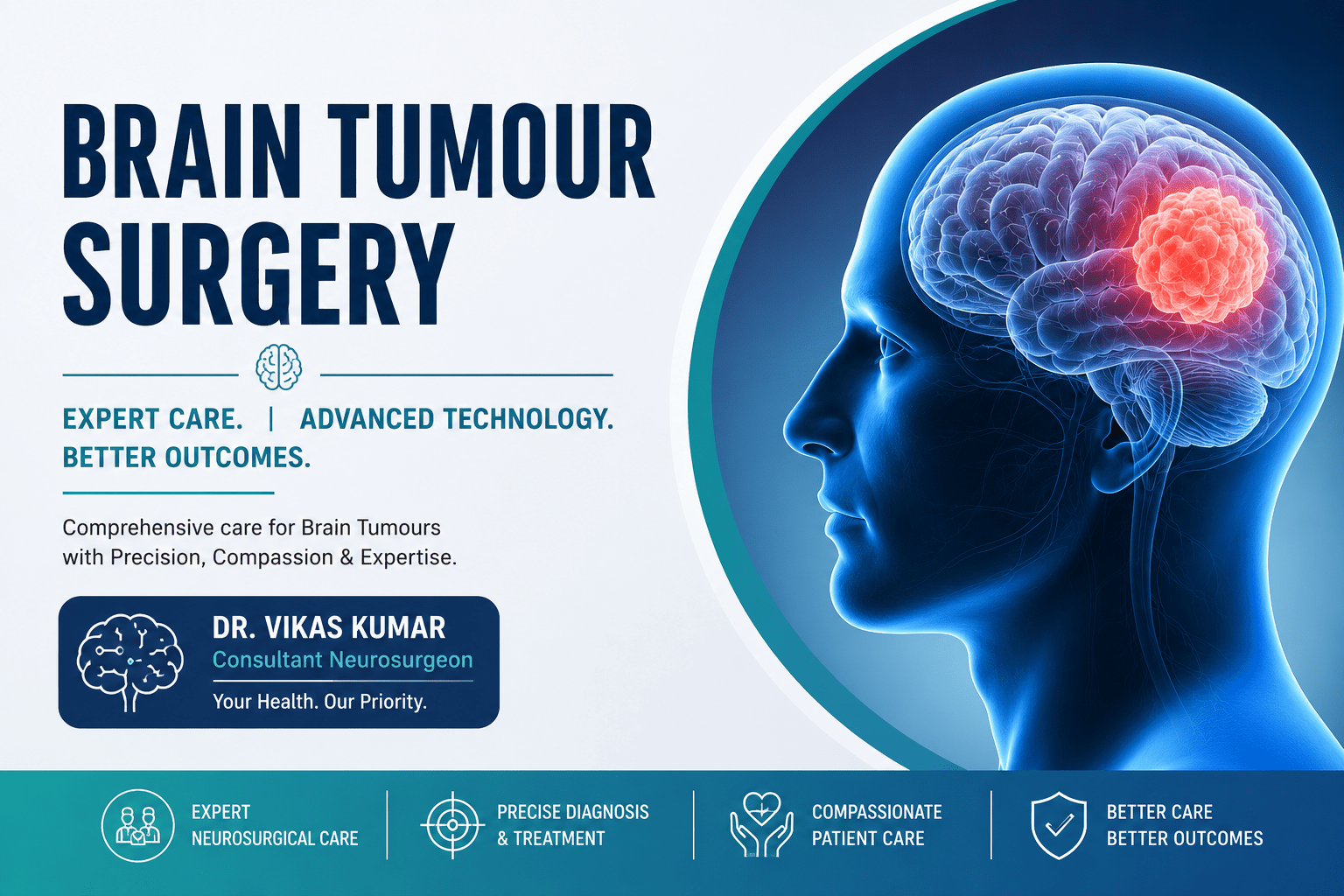
A brain tumor diagnosis for a patient and for his/her family is a very tough situation. People often ask questions like What are the symptoms of brain tumor? Is surgery necessary? What is the brain Tumor surgery cost? recovery time? What is the brain tumor success rate? Well, thankfully, improvements in neurosurgery have made treatment for brain tumors safer and more effective than before In India.
In this blog you will get information and explanation about, brain tumor meaning, brain tumor surgery, brain tumor symptoms,brain tumor causes, diagnosis of brain tumor, procedures for surgery, recovery, risks, success rates and factors affecting the brain tumor treatment cost in India.
What Is a Brain Tumor?
Understanding the Brain Tumor meaning is the first and important part for recognizing the condition.
Most people immediately associate a brain Tumor with brain cancer,
So in brain Tumors an abnormal mass of cells grows within the brain or surrounding tissue. which might be cancerous(malignant) and non cancerous(benign).
The types of brain Tumor can be classified as:
Benign Brain Tumors:
The benign brain Tumors are non cancerous brain tumors which grow slowly in the brain, but the serious condition can still be caused if you give more pressure to important areas of the brain.
So in this you should not think too much or don’t give any pressure and stress to the brain.
Malignant Brain Tumors:
These brain Tumors cause cancer in the brain, and grow rapidly into the brain and spread to nearby brain tissues.
Brain Tumors can develop inside the brain itself and are called primary brain Tumors and brain Tumors which are spread from other parts of the body are called secondary or metastatic brain Tumors.
Common Brain Tumor Symptoms
The common symptoms of brain Tumor depends on the size, growth rate and location of the Tumor. Some people experience the system slowly and gradually, while others notice sudden changes.
Early Brain tumor symptoms:
Already knowing early brain tumor symptoms make a big difference, because early care often leads to better results , and sometimes sooner help matters a lot.
Some of the most common brain tumor warning signs include:
- Blurred or double vision
- Difficulty speaking
- Nausea and vomiting
- Persistent headaches, especially in the morning
- Seizures or fits
- Hearing difficulties
- Memory loss or confusion
- Weakness in the arms or legs
- Personality or behavioral changes
- Balance and coordination problems
If you see and experience any of the signs of brain tumor, then you should consult a neurosurgeon immediately.
How I Knew I Had a Brain Tumor
Many people search as to how I knew I had a brain tumor because they want to compare their symptoms with real-life experiences.
The brain tumor most of the times begins as occasional headaches and then becomes more frequent, Although every patient is different, so some has same symptoms and some may experience different symptoms like blurred vision , frequent vomiting, seizures, trouble getting words out, weakness on one side of the body, or these odd personality shifts, with no clear reason.
These symptoms increase time by time and you may see a worsen condition than before, when you see these neurological symptoms then consulting a neurosurgeon is best option.
What Causes Brain Tumors?
The exact brain tumor causes remains unknown. Still, there are a few factors that could raise the risk at least in some people which are:
- Family history of brain Tumors
- Certain inherited genetic conditions
- Increasing age
- Previous exposure to radiation therapy
- Exposure to harmful chemicals in some occupations
And some brain Tumors occur without any identifiable cause.
How Is a Brain Tumor Diagnosed?
Early diagnosis of brain Tumor helps in successful treatment, and it is the most important factor if the brain tumor signs are detected early and also patients will have more treatment options and early recovery outcomes.
Neurological Examination
A neurosurgeon checks out vision, hearing, balance, reflexes and muscle strength, plus that cognitive function stuff, like thinking, memory, and such.
MRI Scan: MRI (Magnetic Resonance Imaging) in the most important technique or test to identify brain Tumors.
CT Scan: A CT can be used in such emergency situations and when the MRI is not available in the hospital.
Biopsy: A tissue sample is collected and used to determine whether the Tumor is cancerous and non-cancerous.
When Is Brain Tumor Surgery Needed?
Not every brain tumor requires immediate surgery, it depends upon several factors, including the Tumor’s size, location, type, growth rate, and the patient’s overall health.
The brain Tumor surgery is recommended by a doctor when:
- Tumor grows rapidly in your brain.
- Tumor is causing significant symptoms
- When the Tumor accessible for safe removal
- A tissue diagnosis is required
- There is increased pressure inside the skull
The goal is to get rid of as much of the Tumor as you can, while keeping normal brain function intact even if it’s a bit of a balancing act. Sometimes it is not possible to remove the complete tumor, if the tumor is located near critical brain structures .
Types of Brain Tumor Surgery
Advancement in neurosurgery made brain tumors less invasive by using advanced surgery options and machines. Depending upon the condition of the patient any of these treatments may be recommended.
Brain Tumor Surgery is classified as:
Craniotomy:
A craniotomy is the most common surgery of brain Tumor in which a section of skull is temporarily removed to access and remove the brain Tumor.
Endoscopic Brain Surgery:
It is a minimally invasive technique in which a thin camera and some specialised instruments are used for small openings, and it is less painful and faster recovery surgery.
Awake Brain Surgery:
In this surgery patients remain partially awake so that the surgery team can examine the speech, movements and critical brain functions.
Minimally Invasive Neurosurgery:
Advanced micro- surgical methods let neurosurgeons remove Tumors through smaller cuts while reducing the harm to the nearby tissues, so it kind of stays gentler around everything else.
Risks of Brain Tumor Surgery
Like many other major surgeries, brain surgery also has risks because the brain is a soft, spongy mass of nerve cells and supportive tissue.
Potential complications may include:
- Swelling of the brain
- Weakness or paralysis
- Bleeding
- Infection
- Seizures
- Neurological deficits
- Memory problems
- Speech difficulties
An experienced neurosurgeon sort of carefully evaluates these risks before the surgery and takes every precaution to ensure patient safety, you know, as much as possible.
Brain Tumor Treatment Options
Surgery is the primary option for brain tumor but not the only option for brain tumor treatment, the treatment of brain tumor depends upon the type and stage of the Tumor.
The brain tumor treatment option include:
Surgery
Removal of brain tumor is done through surgery which is the primary and highly recommended option when the tumor is in worsened condition. It is the safe and most effective option.
Radiation Therapy
This therapy uses high-energy radiation to destroy remaining tumor cells after surgery and to destroy those Tumors which can not be removed completely.
Chemotherapy
chemotherapy works best when the Tumor has that fast cycle, so the drugs can interfere with it, rather than just sit there doing almost nothing.
Targeted Therapy
Newer medicines go after specific genetic changes found in some brain tumors, while at the same time, trying to keep the harm down to the healthy tissue.
Observation
Small non-cancerous brain tumors may not require immediate surgery; they only require regular MRI scans.
Brain Tumor Treatment Cost
The most common concern asked by a patient is brain tumor treatment cost.
The cost of brain tumor depends upon medical condition of patient, there is no fixed cost of brain tumor treatment.
The overall expense depends on several factors, including:
- Complexity of surgery
- Hospital infrastructure
- ICU stay
- Type of brain Tumor
- Hospital room category
- Rehabilitation requirements
- Post-operative medications
- Diagnostic investigations
- Additional treatments such as chemotherapy or radiation therapy
Patients should always ask or discuss with the neurosurgeon before surgery about the expected treatment plan and estimated expenses.
Brain Tumor Surgery Cost in India
The cost of brain Tumor surgery in India varies depending on:
- City
- Hospital
- Type of surgery
- Duration of hospital stay
- Tumor location
- Technology used during surgery
- Tumor size
Large metropolitan hospitals may have different pricing as compared to small cities, complex surgeries involve advanced technologies or prolonged ICU care which may increase the total cost.
Recovery After Brain Tumor Surgery
Recovery after brain tumor surgery of patients depends upon the type of Tumor, location, patient age, and overall health.
Immediate Recovery:
Most patients stay in the intensive care unit ( ICU ) for close monitoring after surgery, a lot of time it’s just to make sure everything remains stable and yes they are watched carefully.
Hospital Stay:
Hospitalization usually runs from a couple days up to around one week, depending on how complex that procedure is. It can be a bit shorter than expected sometimes, but in general it’s a small window.
Rehabilitation:
Some patients who required therapies go to rehabs for:
- Speech therapy
- Occupational therapy
- Physical therapy
- Cognitive rehabilitation
Returning to Daily Activities
Complete recovery after brain Tumor surgery takes months but many patients gradually return to normal activities within several weeks.
Brain Tumor Surgery Success Rate
The success rate of brain Tumor surgery depends on several factors which are:
- Tumor location
- Tumor size
- Tumor Type
- Patient’s overall health
- Stage at diagnosis
Non cancerous brain Tumors(Benign) have excellent results after brain Tumor surgery and when Tumor removed.
Even for Complex Tumors The modern Neurosurgery techniques are now improved which has also improved survival rates and quality of life.
Life After Brain Tumor Surgery
Most of the patients after weeks of surgery return to their normal productive and fulfilling lives following successful treatment.
Regular checkups, appointments, MRI monitoring helps to monitor the recovery and detect any reassurance at an early stage.
Patients are encouraged to:
- Follow medical advice carefully
- Report new symptoms promptly
- Maintain a healthy lifestyle
- Attend scheduled follow-ups
- Eat balanced and nutritional food
- Avoid smoking and alcohol
Why Choose an Experienced Neurosurgeon for Brain Tumor Surgery?
For Brain Tumor Surgery you should consult with an experienced neurosurgeon who has years of expertise in advanced technologies and meticulous surgical planning.
By choosing an experienced neurosurgeon will improve your treatment outcomes and reduce the complications.
Dr. Vikas Kumar a specialized and experienced neurosurgeon in Jharkhand, known for managing complex brain Tumors, strokes, spinal disorders, neurotrauma and minimally invasive neurosurgical procedures.
Consult Dr. Vikas Kumar for Brain Tumor Treatment
If you or your known one is diagnosed with brain Tumor then you should firstly consult with the best and experienced neurosurgeon for timely evaluation and surgery procedures.
Dr Vikas Kumar, who is a neurosurgeon in Ranchi provides expert diagnosis, surgical treatment, comprehensive post-operative care for patients suffering from brain Tumors and other neurological disorders.
He offers services like brain Tumor surgery, endoscopic neurosurgery, spine surgery, stroke management and neurotrauma care. Sometimes people also get help for brain related injuries, and that kind of urgent care, from him.
His expertise includes:
- Brain Tumor Surgery
- Brain Cancer Treatment
- Endoscopic Brain Surgery
- Minimally Invasive Neurosurgery
- Stroke Management
- Brain Hemorrhage Treatment
- Spine Surgery
- Slip Disc Treatment
- Neurotrauma Care
- Epilepsy Surgery
- Deep Brain Stimulation (DBS)
Dr Vikas Kumar also provides consultation Over calls, so you can connect with him over phone calls.
📞 Book an Appointment: +91 94713 70055
🕒 Available: Monday to Saturday
Book your consultation today for expert guidance and personalized treatment planning.
What causes brain Tumors?
The exact brain tumor causes are often unknown. Risk factors include inherited genetic conditions, previous radiation exposure, increasing age, and family history.
Is every brain Tumor cancer?
No. Many brain tumours are benign (non-cancerous), while others are malignant and classified as brain cancer.
Is brain Tumor surgery always necessary?
No. Some small or slow-growing Tumors may only require regular monitoring with MRI scans. Surgery is recommended when the Tumor causes symptoms, grows rapidly, or increases pressure inside the brain.
What is the brain Tumor surgery cost in India?
The brain tumor surgery cost in India varies depending on the hospital, city, Tumor type, complexity of surgery, and duration of hospitalization. Your neurosurgeon can provide an individualized cost estimate after evaluation.
What is the recovery time after brain tumour surgery?
Hospital stay usually ranges from 3 to 7 days, while complete recovery may take several weeks to several months depending on the patient’s condition.